Showing posts with label review. Show all posts

Wednesday, 8 December 2010

Review: Rage HD (iPhone)

There must have been much excitement amongst fans when ID announced RAGE for the iPhone, even more when it was first demoed as an example of the versatility of the company’s Megatexture technology. The thought of having a lavishly grim and detailed mutant populated world in which to roam around in must have been as alluring as it was too good to be true. And indeed it is, because anyone at least half expecting an open world, or even a closed off, linear FPS experience on Apple’s portable powerhouse will be disappointed. Because RAGE in this guise, is absolutely nothing like that at all.


In many ways RAGE plays upon the strength of the iPhone in delivering a short but entertaining excursion into the low down and dirty wasteland contained within, using the device’s trademark touch screen for simple control and a journey that barely kicks off, to keep things from getting too repetitive before the end is reached. It is you could say, the antithesis of what to expect iPhone gaming to be all about, having more in common with Sega’s HotD series of lightgun games than the title’s own console bigger brother.

Even compared to basic, twenty year old shooters like Doom or Wolfenstein, RAGE is pretty simple. It’s meant to be. It’s something you can pop into and play for a few minutes, before trying again to beat it a few hours later. So, the game follows the tried and tested blueprint found in on-rails shooters pretty closely, with a dashing of FPS targeting for your pleasure. You are automatically moved around the environment via the game’s camera, while control of a cursor allows you to aim and shoot enemies as you are tightly directed to the next location.

There are only a handful of levels to work through, along with the same number of mutated enemies in which to kill, and three weapons to use (pistol, AK-47, and a shotgun). The difference comes into play with the ability to doge incoming attacks, and being able to control the outcome of your reloads with a reload bar of sorts, which allows you to rack up extra damage if you manage to get the icon in the sweet spot indicated on screen. It’s like Gears in this regard.
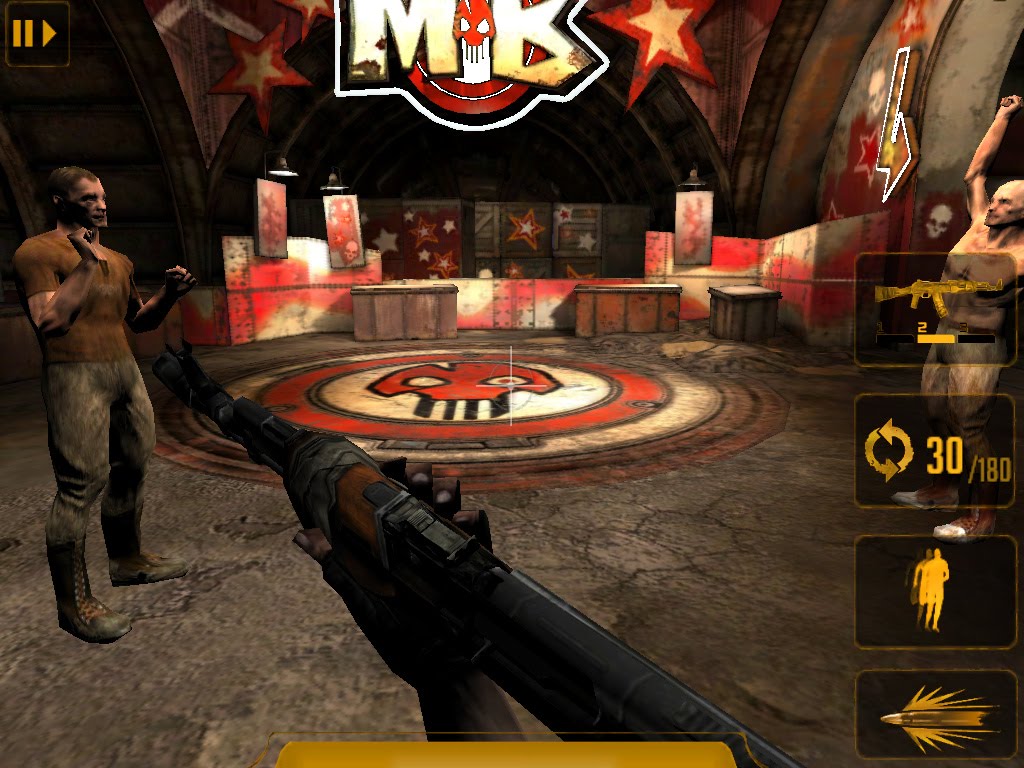

The sheer simplicity of it all however, is given a noticeable amount of depth with the reload system at hand. You’ve only got a limited number of shots before having to reload again, and timing in this regard, to score the best combo, thus dealing the maximum amount of damage per shot, is essential. Since there is no way of making a last ditch melee attack from the late bumrush of foes you can encounter (dodging isn’t always an option this late in the game) knowing when to shoot, where to shoot, and how to reload with efficiency, all plays a significant part in expanding the overly simple experience as a whole.

Another, is the game’s cleansweep style bonus system, whereby if you manage to get through an entire stage without getting hit, your points score dramatically grows in size. The more kills you make without getting hit, the bigger the bonus paid out at the end. And this scoring system is backed up by the ability to gain even more extra points by shooting down the many flip-up target boards that appear throughout each stage.

While at first all these layered elements to gameplay may in fact be beneficial, the game’s controls simply don’t do them justice. Perhaps if RAGE was simply a HotD clone, where all you do is tap on the enemies to kill them, then maybe things would feel a touch smoother, making you feel like you had more control over your actions.


Alas this isn’t the case. Doing everything the game asks of you whilst the camera is moving, while you are attempting to balance out dodging and reloading before making that last ditch precision shot, can often be quite difficult. Use of the touch screen controls often means that your thumbs can obscure vital parts of the screen. And during times where the camera is quickly moving to the next location - while you are still aiming at things - response times can feel sluggish, and the method of input, inadequate for the task at hand.

But of course, this isn’t so much a flaw with the game itself - more the iPhone, which clearly wasn’t made for these kinds of faster-paced action titles. But then again, maybe id’s decision to toe the line between basic on-rails shooter and HotD clone wasn’t the best choice given the medium it occupies.

Instead, I found it far easier to use the iPhone’s tilt functionality in order to aim around the screen, rather than rubbing my finger all over it in order to target my foes. Playing RAGE this way allows it to feel far more like a responsive on-rails FPS, with headshots being more down to skill rather than a spot of clumsily controlled luck. The downside, of course, is the fact that moving the iPhone around means that your view of the screen is constantly changing. And this isn’t such a good thing. However, controlling the game via the tilt mechanism is a far better option than using the touch screen.

Control quirks aside, RAGE was made to impress with its potential graphical prowess. And in this regard the game excels beautifully, looking very much like it belongs on Nintendo’s upcoming 3DS than it does on you fancy mobile communications device.


Here, Carmack and co showcase some nicely detailed environments, with bump-mapped enemies and impressively baked shadow routines. Compared to Epic Citadel, RAGE may not throw around quite as many basic shader effects (it is in fact fixed function). But then again, it has multiple characters on screen. And however simple it appears to be, feels more like an actual game than just a fancy tech demonstration.

It is a shame then, that the experience doesn’t last quite as long as it should have done. RAGE is only a paltry three levels long, with little else to do once the game has been completed. There is literally nothing to hold your attention outside of replaying the same stuff over and over again, even if it does look mightily impressive for a handheld game.

However, this stubbornness to exceed anything other than the size of a beautifully created, but obviously short tech demo, is exactly the philosophy that several games on Apple’s life conquering device follow to the letter. And with great success I might add. Where RAGE begins to fail though, is with the lack of any online support at all. While many other iPhone games rely on similarly short and constantly replayable bitesize chunks of fun, they make up for it with online leaderboards and other such features, which often pitch players off against each other in getting the highest score and the best ranking.


With the iPhone version of RAGE, id software seems to have come up with a great idea, but without having the real drive to do anything other than the basic, barebones treatment with it. RAGE works as a series of short, subtly deep experiences, with lovely graphics to boot. But doesn’t manage to free itself from being anything but a testing ground for something bigger in the future.

That said, at only 59p for the SD version, and £1.19 for the superior HD edition – which works on the older 3GS model, but with inferior performance – it doesn’t need anything else to offer considerably value for money.

And that’s the point many seem to be missing. Not only is RAGE cheaper than a cup of coffee – it’s like half the price – it’s also cheaper than most things you can buy. So in that sense, for a game, it is well worth the asking price, even if what we have here really is just an interesting, entertaining, albeit expanded technological demonstration of what the iPhone can do.

VERDICT: 7/10

Monday, 6 December 2010

Review: Super Mario All Stars (Wii)

For many people their first experience of playing a videogame system was with the original Super Mario Bros on the Nintendo Entertainment System in the late 1980’s or early 90’s. Squishing a Goomba, kicking a Koopa shell across the ground, or jumping up to a ‘? Block’ releasing a Super Mushroom. These were the beginnings of a journey that would take people into a whole new world of gaming goodness. I still remember the impact the NES, and specifically Mario had on my life, transitioning from a green screen Amstrad to Nintendo’s 8bit spectacular.

When Nintendo decided to release the original four 8bit Mario games to a new audience in 1993 on the Super NES, I was there waiting. I always preferred the likes of Super Mario 3 to Mario World. Although, today the Big N’s first and only proper 16bit excursion into the Mario universe clearly stands out as being superior. But for me, even now, there’s still something SMB3 delivers over and above any other game in the series to date. So back then having the very best the series had to offer all on one console was like a match made in per-pixel heaven.

Super Mario All-Stars brought over the delights of the original Super Mario Bros and its sequels, Super Mario Bros 2 and 3, whilst making available for the first time in the west the Japanese only SMB2, in the form of Super Mario Bros: The Lost Levels. All four games came complete with reworked 16bit quality graphics and sound. Mario now looked recognisably similar in the original SMB as he did in SMB3 – clearly tying in the first and third games together as sequels even more closely - while the backgrounds were given addition polish in the form of parallax scrolling and additional colourings and detail.

The music and sound effects were given an overhaul too, helping to create an atmosphere which brought the Mushroom Kingdom to life in a way the aging 8bt NES never could.


For me All-Stars represented the quintessential collection of Mario games: everything from the basic beginnings to the advanced direction of Super Mario 3 and everything in between. And this is exactly what we have here.

Marking the 25th anniversary of the birth of an entertainment legend (Mario spans far more than just games - toys, TV shows and more have all been persistent over the years) Nintendo has ported over the Super NES version of Super Mario All-Stars exclusively for Nintendo Wii owners. None of the games on this collection are available in their 16bit form on the Virtual Console. And on top of that Nintendo have also included a soundtrack CD and some history of memorabilia, just giving a tiny insight into the development of the series without really providing anything other than basic info. It’s like a fancy timeline with short developer comments for each game.

There’s almost no point in going into any detail on each of the individual titles found here. Most of you know exactly what to expect.

The original Super Mario Bros layed down the blueprint for the modern day platform game, with multiple worlds each with their own look and doppleganger Boweser end boss, the inclusion of power-ups etc, while the sequels expanded on the gameplay concepts found here in SMB: The Lost Levels and SMB3. The US and European versions of SMB2 of course took a different route, being based on the Japanese exclusive platformer, Doki Doki Panic.

All are excellent games, each with their own highlights and plus points. With SMB: The Lost levels, you can also add incredibly high difficulty to that list too.


Out of all the games available on this collection, it is arguably Super Mario Bros 3 that stands out the most. Even now it is still candidate for being the best Mario game in existence, alongside Super Mario World and Super Mario 64. Looking back now, it’s not hard to imagine the level of impact the game had on the world. But suffice to say, it was revolutionary to say the least.

Again, like with the original SMB, you had eight worlds to explore. But this time they were even bigger, with nearly double the amount of stages in each and loads of secret areas and levels to find, all of which were represented with a colourful map screen. You could now also accumulate a multitude of power-ups, thus being able to start off with one of many at the beginning of each stage if you had some in reserve. And there were loads of these to try: Fire Mario, Racoon Mario, Frog Mario etc.

Back in the day the game was also mildly criticised for its slightly high difficultly level, and this is still apparent now. Although by adding a save point midway through each world – the actual levels themselves can be rather hard, but are never unfair - this could be easily fixed.


Moving on, and in terms of the conversion itself, Super Mario All-Stars is on the whole actually very good. It isn’t quite perfect, lacking any option to be played in its original resolution. But otherwise Nintendo have done a great job. The port appears to be a straight up emulated version of the Super NES cartridge, meaning that there are no Wii specific options to be found anywhere, and the front end and all on-screen prompts are exactly the same as they were before. The game has also has been given the full 50Hz PAL optimisation treatment. It runs in full screen, at full speed, but without any widescreen options available.

However, there is no original 240p display mode available like with VC titles. Instead All-Stars runs in 480i when using both RGB SCART and Component cables. The result is a game that looks incredibly flickery when played on SD CRT’s, meaning that trying to view it as intended – or as close to – is largely uncomfortable. It’s such a shame as this was something we, along with most hardcore fans, were expecting. That said, the game does upscale very well in its 480i guise on my HDTV. And with no flicker, making it by far the best way to play given the choice.


The actual core of the collection overall is superb, as expected. Each and every one of the games included on this package is worth the price of admission as separate VC titles alone - sans perhaps SMB: The Lost Levels, which still feels far too difficult for its own good – and the port itself is as solid as they come.

One slight disappointment though, is that Super Mario World has been excluded from the pack. Seeing as the All-Stars package was updated to include it back in the mid 90’s, quite why it is absent here is rather perplexing. While it is indeed obvious that Nintendo would want to sell the first true 16bit Mario title as an added extra via their VC store on the Wii, one can’t help think that SMW - and perhaps the 8bit originals - deserve a recognised chunk of space on the disc. And when you consider how many top-selling Megadrive titles Sega puts on its collections, you can’t help but feel a little short-changed.


Another slight letdown comes with the inclusion of the soundtrack CD and history book. Nintendo could have padded out the book with at least a few pages of more elaborate info and more unseen artwork for each of the four titles. But instead, all we are given is a barebones treatment of sorts. There are some cool photos of level design sketches and concept art to see, along with shots of promo material and developer comments to go with each game. It’s all been nicely arranged, and acts as a rushed, but pretty good companion piece to the package’s excellently produced instruction booklet, but hardly goes the extra mile to please fans despite some neat little touches.

The soundtrack CD contains a range of tunes and effects spanning from the original SMB to Mario Galaxy, coming complete with a small range of signature music and a small collection of sound effects. Altogether, the extras here aren’t bad but seem somewhat lacking for a 25th anniversary re-release spectacular of what are arguably some of Nintendo’s most revered hits.


Still, at £24.99 Super Mario All-Stars can be considered fairly priced. Each one of these titles would have retailed on the VC at a reasonable £5 a piece. So for the extra £5 we get all four games in a box with cool, if shallow booklet and soundtrack CD. The games themselves are as awesome as you remember them to be, gracefully standing the test of time while providing a perfect example of just how to create satisfyingly challenging experiences.

Besides that, little else can be said. Sure the lack of 240p support is a bummer, and the extra stuff merely scratches the surface of what could have been included about the background and development of each title. But don’t let that stop you. Super Mario All-Stars is easily worth picking up to relive a small slice of exceptional gaming history, and for those who have yet to sample these delights. Definitely, more could have been done to make the whole collection worthy of the 25th anniversary banner, although the games themselves still make it worthwhile for fans and newcommers alike.

VERDICT: 8/10

Screenshots and images courtesy of IGN and NintendoLife.

Sunday, 28 November 2010

Review: Crazy Taxi (XBLA)

Way back when Crazy Taxi was first released in the summer of 2000, it felt like an 8/10 game. It may have been a rather simple and particularly shallow arcade experience, one designed to quickly sap those £1 coins away from your wallet and into its cabinet’s mechanical belly, but it was an extremely fun ride while it lasted. The Dreamcast conversion was almost completely arcade perfect, but aided in increasing longevity by adding in another city in which to drive around, and a cool mode full of wacky driving mini-games in the form of the Crazy Box.

Now Crazy Taxi has returned to the scene in a supposed HD re-release over both Xbox Live and PlayStation Network. However, while everything looks almost as you remember it, the actual game as a whole has undergone a few tweaks and changes that seemingly take away from the originally inspired OTT outing.

For the most part, much is the same as I remember it. There’s two basic modes on offer here - Arcade and Original - each with their own take on things, and two separate stages in which to ferry around easily displeased passengers in. One of these comes directly from the arcade game, while the other was created specifically for the DC conversion itself. Four different cabbies are available, each with different handling characteristics and driving capabilities.


The basic blueprint of the gameplay then, has been left unchanged, except perhaps for a difference in handling. Instead you’ll find that most of the superficial stuff – the stuff that actually mattered the most – has been altered in order to save on the licensing fees Sega don’t seem to want to be paying.

Take the music for example. Part of the fun of playing CT wasn’t just rampaging across a fictionally mapped San Francisco while giving passengers the daily ride of their lives, but rampaging along whilst the philosophical lyrics of Bad Religion’s ‘Them and Us’, or the energetically youthful screams from The Offspring’s ‘All I Want’ indoctrinated your mind in a blaze of punk rock inspired mayhem.

Sadly, these are nowhere to be found. Instead, arguably the main draw of the original has been replaced with a series of bland, indie rock songs which are neither iconic, nor worthy of replacing the brilliant fusion that was once contained within. Whereas before the music helped maintain a conscious rhythm keeping you speeding along even faster as the timer briskly made its way to zero, the new songs found here simply grate. Their default volume is also too loud, thus drowning out the rest of the game.


The rest of the licences don’t fare any better. Like with the music, they’re simply not here at all. Nope, line’s such as ‘take me to Pizza Hut’ or ‘I wanna go to the KFC’ have been replaced with the likes of ‘Pizza Place’ and ‘FCS’ (Fried Chicken Shack), along with different voice actors and a tone failing to capture the spirit of the original. It’s pretty strange to see the key elements that made CT work so well torn out and replaced with poor substitutes.

The question is, why did Sega not simply extend the licences for use in this re-release? Have they become so poor that they couldn’t afford for a ten year old game to relinquish it’s aging licences, or did they simply not give two pence to make it happen? I don’t know, but something tells me it was the latter. Although, the very way the whole system works is as much to blame. Why should publishers have to pay for licences on game that they’ve already paid for before? Because, apparently, they expire after a certain time.


In my opinion, it’s an archaic and thoroughly over abused system, which can, if allowed to, regularly ruin the classic feel of older games with their modern day re-releasing. Of course that’s just how things work, and in any case the decision to extend the licenses should’ve been taken when someone though it would be a great idea to make CT available once again.

Outside of not having the music or places I remember, other areas have also been reworked for unknown reasons. The voices for all four main characters have been taken from the PS2 and GCN ports – that is to say they are different from the DC original. They’re certainly not as good. They sound nasally and distinctly off. Plus the game’s handling mechanic has been pulled right out of its sequel Crazy Taxi 2, and not from the first game of which this is supposed to be a port.

The tighter nature of the handling is actually okay… just about. But at the same time feels more suited to the confined city streets of New York depicted in CT2 rather than here, in the more wide-open landscapes of San Francisco.


Sadly, the XBL and PSN version of CT is an uneasy mix of fragmented parts of the PC, PS2, and DC games without solidly being based on either one, lacking the polish required to be a hit, along with any sense of care or attention. This is also apparent when you hear the overly compressed voice samples, and poor quality music used in the port. At least, unlike with Sonic Adventure, we've finally got proper widescreen support. But only when you actually begin playing the game - the menus are of the stretched out 4:3 variety.

But despite all the little changes here and there which break up the solid flow of the cherished original, Crazy Taxi in its current form is still reasonably fun to play. The cool challenges of the ‘Crazy Box’ are still just as wacky and innovative as ever, and the simple nature of the gameplay is something that is missing from too many of today’s arcade driving games. However, without the licences or the handling of then original - which made it great back in the day, Crazy Taxi feels like an empty shell, a shell that’s had its soul and personality – its innards if you will – ripped out and discarded for all to see.


There is a great little arcade title locked inside this half-assed port. Sadly that game has been carved up and re-created without the same level of distinct charm and composition, which it needed in order to hold up well today. In the end, Crazy Taxi is still fairly enjoyable to play. But without a large sum of its original parts, is no longer the experience it should have been – it’s distinctly average. Any solace comes from the fact that the bulk of the main arcade game can be played through via the demo. No need to waste precious MS or PSN points then.

I loved the Dreamcast version of Crazy Taxi, but I can’t say that I’m all that enthused, or even appreciative of what we’ve been given here. Sure thing Sega, feel free to give us a port of the original game. But do just that. Do it right with everything left intact, and not with what looks like a partially emulated rush job straight out of a backyard chop-shop.

VERDICT: 5/10

Thursday, 18 November 2010

Review: Call Of Duty: Black Ops (360)

Ignoring reality, Black Ops firmly has its feet solidly in the realms of fantasy: Busting through a set of doors before busting a cap in the head of Fidel Castro is clearly a world away from such endeavours black ops units actually get up to. But then again, we never know. Certainly not with a team designated to perform operations that no upstanding military commander would authorise - at least not officially, and that is what makes Treyarch’s latest an interesting tale.

So this instalment in the award-winning Call Of Duty series once again further allows itself to be larger than life, with intense set pieces and non-stop gunfights for terrain supremacy, funnelling you along corridors in what looks like an FPS gallery shooter with firm homage’s to yet more Hollywood movies. Then again, this is exactly what Modern Warfare turned the series into. But even before, it was heavily branching down the path of arcade realism. Black Ops simply lives up to this premise. It’s here to please those grown accustom to the series trademark style, and unrelenting ballet of bullets.

It’s not that I particularly mind this forte of action. In fact I rather like it. The balance of near constant shooting, with brief pauses in between to regenerate health, commandeer a fixed-turret machine gun, or in order to quickly take a breather and assess the situation is exactly what makes this series tick. However, Black Ops also shows that the now well-worn formula works even better when combined with a more coherent storyline, and a focus on individual characters, however small, rather than being an all out mish-mash of convoluted James Bond-esque set pieces and mindless exposition.


Here, you spend most of your time in the shoes of John Mason, a Black Ops team member that now finds himself captured and being interrogated about events from past missions. Hidden behind a smoky glass window, an un-named spook attempts to extract vital parts of your service history, which are presented through various flashbacks as you succumb to the pain inflicted. These flashbacks comprise the game’s long sea of missions, taking you through Vietnam, Cuba, Russia, and back again in a heightened Cold War era tale of misinformation and distrust.

Essentially, through these flashbacks Black Ops tracks your progress taking part in everything from the apparent assassination of Castro, and discovery of a chemical weapon – the potent never gas, Nova 6 – right the way through to hunting down the Russia generals and Ex Nazi commander responsible for the new terrorist threat.

At first the story seems somewhat disjointed, almost feeling dazed and confused like John Mason in the chair he finds himself strapped down to. However, as more of Mason’s memories come flooding back to the surface, and as the elaborate tale unfolds as a whole, everything becomes clear as day, with Black Ops keeping you gripped with its focus on giving away brief snippets of information via short and snappy cut-scenes.


To that end the single player campaign is a more tightly reigned in affair compared to MW2, with emphasis on big budget Michael Bay style set pieces, and a near constant barrage of action. It is never quite as overdone as some of the things found in Infinity Ward’s last COD title, with the larger events feeling more realistic in a warped sense of the word. Plus, the game tries to keep a balance between the large explosive encounters and quieter missions that are based around stealth or a brief moment of tactical combat.

Outside of these ebb and flow elements to the action, the straight forward shooting is broken up even more with several vehicle sections whereby you take control of helicopters, boats, and a tank in bringing about some stylised destruction. What’s cool about these, is that some have been deliberately influenced, and dare I say, going as far as ripping off various Vietnam flicks of the past thirty years of so with the use of licensed soundtracks and iconic confrontations – it all makes the fictional story, and the combat more natural when compared to some of things the series has thrown at you before (the nuke in COD4 anyone?).


Black Ops also takes the time to stretch out the battlefield even further than before, providing players with larger, more open spaces in which to take part in elaborate battles that have to be handled a little differently. Like with the rest of the game, there are always a few carefully orchestrated set pieces to be found amongst the endless amounts of enemies to kill.

However polished most of the action is throughout – and it is a superb, well-constructed affair - Treyarch don’t always seem to get it right all the time. And in too many of these open battlefield sections the old case of respawning enemies rears its ugly head once again. Ultimately, there’s little you can do other than to shoot down a few them before making a run for it to the next checkpoint, thus stopping the endless flow of potential cannon fodder.


The first Vietnam stage is home to the most obvious, and easily the worse implementation of this in the entire game, whereby, as you are making your way down an embankment to the trenches below over the horizon literally dozens of enemies continuously head your way. Sure, you can push over a few barraels and set them alight to keep odds stacked in your favour. But if you don’t… its run and gun until you reach the next section.

This is perhaps the main difference between Black Ops and Modern Warefare 2 – other than having a more succinct and character driven narrative – in which the game feels like its relying on an old, thoroughly worn out tactic to deliver a challenge that could’ve been handled far more intelligently. It’s no deal breaker. And other than a few short spells of frustration here and there, the campaign is handled with a lot more reserve and direction than expected.


Black Ops’ single player expedition through the cold war era is firmly solid and handled with minute precision. Cool touches like licensed music and the inclusion of real life figures such as president John F Kennedy add weight to the proceedings, whilst the gameplay is cut from the same cloth as previous Call Of Duty’s, almost feeling a little too comfortable in its own skin.

As you’ve probably guessed, progression isn’t a word Black Ops understands, nor heeds to at this point. But then again it doesn’t really need to, not when the overall game is as polished as it is. The gameplay, although tried and tested, perhaps even a little stale, is still as involving as ever, and the more focused nature of the campaign helps it shine through any excursions of monotony. As Modern Warfare 2 demonstrated: being bigger doesn’t necessarily mean better. And this is one cliché that Black Ops thankfully manages to avoid.

Like with all Call Of Duty titles though, the campaign is just for starters. It could be argued that the multiplayer – especially online – is firmly on the charge, delivering an automatic spray of replay value well after the cold war conflict of the single player outing has happily exhausted its supply of conscripts. Black Ops then, doesn’t disappoint. With a range of inspired new game modes, and a return of World At War’s fanatically popular ‘Zombies’ Treyarch again have shown command of a franchise they originally were criticised for taking the reins of.


It’s no surprise then to learn that online and multiplayer is exactly where the franchise has taken its biggest steps forward. New modes, and a currency system of sorts expands and complements COD’s trademark use of perks and the established procedure of ranking up as you play, with the ability for greater levels of customisation amongst players whilst adding variety in an increasingly familiar environment.

The use of the new COD points for one, allows you to purchase weapons, clothes, and abilities in the form of perks instead of simply ranking up to get such items. Interestingly this adds a lot more variety to the proceedings without the expense of making the experience feel un-balanced. It’s pretty coo to gain new things more quickly, rather than having to battle it out in endless online matches in order to rank up to do so.

You can even gamble away these points in a series of free-for-all modes called Wager Matches, in which a variety of game types are available. Highlights include One in the Chamber, whereby each player is only given a pistol with one bullet, a knife, and three lives, and Gun Game, in which players start off with a pistol and are given a new weapon with each kill. Getting knifed gives you back the previous weapon, while getting a new one means that you’ll have to quickly adapt to using weapons you may not be very adept at using.


Also as mentioned earlier the Zombies mode from COD: World At War makes its riumpant return, but this time is expanded upom with several maps, and the ability to play as either of John F. Kennedy, Richard Nixon, Robert McNamara, and Fidel Castro while battling Zombies in The Pentagon, which is pretty cool to say the least. Four players can play online in co-op, whilst there is the legacy two-player split screen option for those who want to be in a room with ‘real’ people.

If there’s anything to complain about, it’s that the game’s matchmaking service is a little slow, and the online co-op campaign of WAW is strangely absent. Besides that Black Ops takes some large strides forward in delivering the deepest, most satisfying range of multiplayer modes to date. The combination of perks, rankings, with COD points and a range of excitingly geniuos new modes helps keep it right up there along with the awesomeness that was the original Modern Warfare online.


Unusual as it first may seem, it appears that Call Of Duty Black Ops well and truly does deliver. There is always a risk of creating an instalment that fails to differentiate itself enough from past games, or one which strays a little two far from the crows nest. However, Black Ops does neither. Instead, it balances a fine line with a single-player campaign that simply treads old ground in a more coherent manner, and a multiplayer in which it mixes up the familiar helping to keep it exciting.

And overall, as complete package there’s simply no doubt that Treyarch have done a reasonably stellar job here. The level of polish, and expertly crafted, fast-paced, visceral action takes a page right out of the Infinity Ward rulebook, but doing it better than MW2, and with even more style. It can be said with confidence that the studio should no longer be looked at under the cloud of IW’s past successes, but instead as a solid team on their own, with their own take of what Call Of Duty should be.

VERDICT: 8/10

Wednesday, 10 November 2010

Review: Time Crisis: Razing Storm

There was once a time when arcade lightgun games were some of the most popular gaming experiences around, and some of the most graphically impressive. You only have to go back seven or eight years with the likes of Time Crisis II and 3 to see the impact such titles had. And the latter even managed to showcase some decidedly lovely PS2 visuals. Obviously, these days things are a little different. In fact, they are very different indeed. The day of the lightgun blaster is long gone, and in its place a barrage of first and third-person shooters, and western-influenced Japanese arcade titles.

Time Crisis: Razing Storm does nothing to stop the decline, being stuck firmly into the past with regards to production values, voice acting, and repetitive mediocrity as the core shooting mechanic fails to sustain your attention. It’s not a case of gaming having moved on, but rather, that most lightgun games are pale imitations of their former selves – something that is apparent right away when you play this collection.

On the Blu-Ray Disc, Razing Storm contains not one, not two, but three separate arcade releases. You’ve obviously got the new Razing Storm Time Crisis game, alongside of which we find another recent arcade shooter, Deadstorm Pirates, and the older, previously released Time Crisis 4. Out of these three games, two are machinegun based titles, whilst the other (TC4) is more traditional affair, but with a few added gameplay changes.


Razing Storm isn’t so much a sequel to Time Crisis 4, but a spin-off from the series. Instead the game looks like a follow up to Namco’s Crisis Zone - a machinegun, play and spray instalment in the franchise. While keeping the series familiar duck and reload mechanics in hand, the game sees you with your finger almost constantly down on the trigger, blasting away at dozens of enemies at a time, and rarely using anything other than a weapon capable of firing hundreds of rounds per minute. That is to say, that Razing Storm is more OTT rather than presenting you with a skilful shooting gallery as found in Virtua Cop.

Balancing out the game’s approach of near-constant shooting, enemies all have small health bars that must be depleted, and subsequently lots of bullets are required to take them down. On the upside, you won’t be getting shot all of the time. Instead, enemies become surrounded by a red or blue cursor that bleeps when an attack is immanent. The result: that you’ll only have to duck and defend either to reload, or when those bleeping markets appear on screen.


Other than the enemies themselves, you can shoot at almost anything in Razing Storm, and most of it is completely destructible. Tables and chairs can be blasted into pieces; windows can be shattered; and even large chunks of buildings and other solid objects can be damaged - the range of destruction is pretty impressive. At one point I was able to blow up nearly an entire row of buildings in sea of trigger-happy melodrama. Although lacking the full scale devastation that Battlefield Bad Company and its sequel has to offer, it is far from being just superficial.

However, the suitably destructive scenery does come at a cost to the visuals, which are pretty basic to say the least. Static lighting, poor texturing, and blocky environments are hardly an adequate concoction for a current-gen game, least of all a full price one. Given the low popularity of such a title, and the ongoing decline of the arcade industry in general, such a lack of polish, and indeed production values, is all but guaranteed. I would say that what we have here is merely satisfactory, though bland and un-inspired at the same time – the bloom lighting, though overdone is rather nice. Loading up TC4 once again shows that some of the artistic vibrancy found in similar titles made just a few years prior, is largely absent here in Razing Storm.


On top of the standard lightgun shooting Arcade Mode, and Razing Storm also adds an additionally fleshed out Story Mode too. This is basically like a FPS of sorts, with you having to move around whilst aiming and shooting. The control set up using the Move works very similarly to that powering most Wii first-person shooters, but is worse in execution. Even more so than with the main Arcade Mode, you’ll find loads of poor voice acting, terrible AI, and some of the blandest gameplay in existence.

Moving and turning is rather awkward regardless of how much you have adjusted the controls, and the action is decidedly pedestrian. Suffice to say, I didn’t bother to even finish this mode. It isn’t what Time Crisis is all about, and quite frankly, it would have been far more beneficial to have some additional stages tacked onto the regular arcade mode instead.

So Razing Storm itself isn’t all that great, although it is backed up by two other rather average lightgun games. Perhaps unsurprisingly, it is Time Crisis 4 that is still the best of the bunch. It features a reasonable blend of precision shooting, whilst taking the time to implement some of the more OTT concepts found in Crisis Zone, and other action titles. Deadstorm Pirates on the other hand, like with Razing Storm, is a far more mundane affair, which only serves to highlight the drop in quality games like this are facing.


Overall, it is Time Crisis 4 which is by far the best this collection has to offer. It balances out skilful shooting with a few spray and play machine gun sessions, and has by far the most replay value of the trio. Sadly, neither Deadstorm Pirates nor TC 4 features their original arcade intro sequences. In fact, there is no intros whatsoever.

Outside of the games themselves, it was the promise of Move support which had me most intrigued. Doing away with the painfully ugly set-up that was the G-Con seemed like a perfect idea, especially as the Move has the capability for even greater precision, but without the hassle. Sadly, even here Namco have missed the boat somewhat. In terms of actual aiming and shooting, the Move performs brilliantly - there’s no mis-firing in which to speak off, and latency was inline with the G-Con.


However, Time Crisis has always required the use of an additional button outside the trigger on the gun itself: the use of a duck/reload button. Now while this was always well catered for on all three versions of the G-Con (with the G-Con 2 being the best), using one of the available buttons on the Move itself feels distinctly clumsy, or really uncomfortable at worst. There’s no option to use a Move plus Navigation Controller set-up, thus allowing for comfortable aiming and easy reloading – something which is already available while using the standard G-Con 3.

Ultimately, the result is that Sony’s Shooting Attachment for the Move is completely redundant. It’s borderline useless for Time Crisis as you don’t have access to a more comfortable reload/ducking set-up. In any case, for pure comfort and overall performance reasons, using the archaic, ‘wires everywhere’ set-up of the G-Con 3 is by far the best option.


In the grand scheme of things, it’s hard to recommend Time Crisis Razing Storm to anyone, including hardcore fans of the series. At full price (it’s £39.99) it neither represents good value, nor a great retro themed experience. You would in effect, be better served by tracking down a copy of TC4 and the G-Con 3 - both of which are sure to cost less second hand – than invest in this poorly put together compilation of decidedly average lightgun games.

Perhaps Namco should provide a Time Crisis 1,2 and 3 HD collection instead. Or even have another stab at the main series with a Time Crisis 5. Either way, lord knows why they bothered with this when there are far, far better alternatives out there. Some people may well enjoy the overtly cheesy nature of Razing Storm and Deadside Pirates, and find them reason enough to dust off that ghastly orange monstrosity that is the G-Con 3, although even they, I think, will feel slightly short changed.

VERDICT: 5/10

Saturday, 6 November 2010

Review: Star Wars: The Force Unleashed II (360)

Star Wars is filled with some of the most familiarly emotive moments in mainstream cinema history: The scene when Luke first discovers his fathers true identity; the scene in which he learns that self-belief is as important a tool in using the force as is any physical training. It’s in these moments you can really see how much the series has truly impacted on our minds not only as children, but also as adults. Sure, the direction is somewhat cheesy, and the narrative decidedly cliché at times, but nevertheless serve to connect us to a world full of imagination and wonderment.

In that respect SWFU II misses the mark by some margin. While the game improves on its predecessor in many ways – the gameplay is noticeably polished beyond subtle touches here and there – the story and direction is a distinctly miss-matched affair lacking in overall focus and artistic flair. Technically, FUII does everything the first game should have done; it’s bigger, better looking, and far smoother with less in the way of bugs and glitches. However, it also cuts away some much-needed variety, with the reduction in enemies and stages making it a far shorter, less complete adventure.

Starting off, and you can see that the combat system, the basic staple of gameplay that makes up FUII is considerably polished over and above that of the first game. Animations are instantly smoother, as is the transition between lightsabre swipes and combined force plus force moves. Combos also flow into each other with much needed fluidity, and the core components which felt a little rough around the edges before, are nicely worked over into an enjoyable mix. This sequel is definitely better put together as a whole.


Starkiller, or should that be Clone Starkiller, has a much more fully-featured repertoire of moves from the get go. His force powers and lightsabre skills are noticeably varied by FUI standards. It is possible to perform force lighting, grab, and burst moves all from the start of the game. Plus combining force moves into light sabre combos is now a regular, and rather useful strategy for combat against a multitude of foes, and not just the ones immune to your electro-powered blade of doom.

Just running around hacking down strings of clueless Storm Troopers is a distinctly satisfying affair. As is blasting them with force lighting, or grabbing them before throwing them head-on into a wall, or a platoon of more unsuspecting troopers. This is now something that actually feels like it is equating to you using Jedi powers.

Or at least initially, for the opening few minutes, after which a veil of uninterrupted similarity and boredom begin to creep in. You see, while the FUII happily smoothens over the original’s rough edges, featuring more fluid combat, and the eradication of a wide range of intrusive glitches, it also fails to amount to being anything more than a polished up version of that very same game. But without the visionary storyline, or interesting plot or character developments.


So, while at first it appears that SWFUII is plenty polished over its predecessor, it soon becomes apparent (pretty early on in fact) that the vast majority of complaints raised about the first game haven’t been addressed at all. Take for example the many QTE finishers throughout the game; the closing few hits against the various enemy druids, and planetary creatures – they all end in the same way. Each particular enemy has only one type of QTE finisher, and they get old really quick.

This is made even worse by the fact that there is only a handful or more of enemy types throughout FUII, and most of these you will have seen before even getting a quarter ways through the game. Repetition then sets in even faster than it did before in the first FU. With only a familiar few foes to dispose of over and over again, the whole notion of becoming a powerful Jedi warrior soon wares off.


Warning signs were of course echoed way back in the earlier stages of development - ever since the team at Lucas Arts stated that the overall range of enemies would be dropped for this sequel there have been concerns. The team said that they wanted fewer foes in exchange for more varied combat; better AI, a wider range of enemy attacks allowing for a more tactical approach. However in reality this boil down to some enemies needing to be disposed of using only certain force powers, whilst others need slicing up with your lightsabre. It’s hardly inspiring stuff.

Outside of the basic combat, the same old frustrating platforming sections return in full force, and began to hamper enjoyment of the game very early on. In just the second stage the game starts to draw up short but equally unappealing jumping sections, whereby judging the angle and distance of your leaps can be a tiresome process. Some even require a double jump, plus dash combo, which usually results in you dashing off the edge of the platform you are supposed to be landing on.


Being a Jedi obviously requires at least some acrobatic prowess, and sections like these should be included. But not like this. You only have to look at the likes of Ninja Gaiden and Prince Of Persia to see just how such acrobatic flair should be done. Traversing the environment, running over it, leaping and bouncing with utmost grace and fluidity is a prerequisite, and not an un-used afterthought like it is here.

This is evident that this should be the case in the game’s many cut-scenes, in which the choreographed battles, although not particular exemplary, display the kinds of things we only wish we could be doing.

Despite being a little hurriedly put together, they do at least bare resemblance to the groundbreaking, but slightly stiff direction work seen in the action scenes from original trilogy. And as a whole, the game’s cinematics do succeed in feeling like a proper Star Wars production. Sadly, they also gloss over the fact that the plot is simply a overlooked rehash of what has gone before, now simply being a series of scenes and environments which cut disjointedly into one another with no coherency, or ryme or reason why such stuff is really happening.


Starkiller’s story has already been told. There’s no need for a re-treading of history. In the first game we saw how the beginnings of the Rebel Alliance was put together, but here, we are given very little tangible expansion of that story. There’s nothing here which remotely engages you like with the last game, nothing which really needed to be told. Essentially, while the original FU provided a nice interlude in between Episodes III and IV, FUII does very little convince us of its place, other than being a short episode of a Star Wars TV show – one that is there to pad things out before Luke, Han, and co arrive to set things right.

You are in effect just a clone trying to find out just who you are in the word, and as the game rolls on you are simply confronted with more questions, and even more child-like rebuttals. Surely, it would have been better to set-up the story with another rouge Jedi warrior, one that hasn’t yet been hunted down, one that could still play a key role. Instead, the story here holds no water, and we never care about Starkiller, let alone what the story is trying to do.


In that respect it is clear that with FUII the developers weren’t really aiming to tell an engrossing story, but instead try to deliver on some of the technical promises they failed on the last time around. And although they have, on some levels at least, succeeded, they have also completely forgotten to take care of some of the major design and gameplay issues which almost broke the original FU, to the point where the latter half of the game (that Star Destroyer incident) was utterly un-redeemable.

FUII isn’t anywhere near that bad, though it isn’t anywhere near as good as it should have been for a sequel. The opening stage is fairly well done, but really, that is all the game has to offer, right there. Later on things just get more repetitive, and more frustrating, with poorly implemented platform segments being broken up with overly familiar combat. The overall graphical polish is superb (good use of AA, better shaders and facial details), and the animations and combat flow far more smoothly than before. Most of the game-breaking glitches and bugs have also been dealt with.


However, despite this as the story draws to a close, and the inevitable final encounter looms, you can’t help but feel that things should have dramatically moved on. Instead, what we are left with is a technically impressive reminder of what the first game could have been, but chopped up, cut down, and delivered with a distinct lack of focus, or narrative care and attention. Combat is fun for a while, and being a Jedi is pretty cool for the most part, but the small and samey nature of the overall experience quickly breeds in boredom.

The Force Unleashed II could have been a thrilling, excitingly fun, and solidly diversive experience in its usage of the Euphoria engine, and cool Star Wars setting. Unfortunately, it is just a glorified tech demo, with some mildly enjoyable gameplay tacked on the end of it, lacking in focus and outstaying its welcome all too soon. It’s such a shame, as the franchise still has so much unused potential. Although we are unlikely to see that now.

VERDICT: 6/10

Wednesday, 3 November 2010

Review: Vanquish (PS3)

Vanquish is an awesome game, there’s no doubt about that. Platinum Games have created a masterpiece of a shooter that blows away any other modern day title that remotely tries to replicate the same blend of intense action and screen-filling chaos, of which there are next to none. Comparisons with Gears Of War may be drawn initially, as the game appears to be a more hectic variant of the duck & cover shooter. However, Vanquish is instead is more like a hardcore, three-dimensional homage to the 16bit run and gun shumps of old, and is as definitively thrilling as it is exemplary.

The best way to describe Platinum Games’ highly stylish, and overly intense homage to classic side-scrollers, is to say that it is like a warped version of Gears Of War on a speed trip. Though such limiting connotations just don’t really do it justice. Sure, you can play Vanquish like a simple Gears clone on easy mode, and the game does have plentiful spots of cover in which to park your backside against, though in doing so you’d be missing the point completely. And by a very large margin.

Perhaps with its use of high-powered, though grounded special abilities, and the instantly cool, but somewhat fiddly to implement weapon cancelling system, the game owes as much to classic, over the top beat’em up romps such as Marvel Vs Capcom as it does to any other contender to the third-person shooting crown. The sheer intensity of the combat; the amount of enemies, effects, and carnage on screen rip apart any misconceptions you might have taking you on a journey into one of the most satisfying action games that I’ve played in a long time.


Starting out initially, the game sees you taking on a few handfuls of enemies using the many walls and concrete cover points in order to take a few second breathers in between the more fierce battles for territory. This is pretty much like every other third-person shooter you’ve experience before. However, very soon after it finally starts to dawn on you that sticking in one place for any length of time isn’t a very good idea; you’re unlikely to stay alive for long doing this, especially as the game ramps up its foe count dramatically the further you push on.

Instead you have to keep moving, whether that be from point to point, or by trailblazing past scores of enemies using your jetpack. It doesn’t matter. The thing is, combat is meant to be fast, furious and often chaotic. The constant change-up between slower enclosed affairs, with wide-open faster paced sections is like the constant ebb and flow of pace in a fighting game.

However, unlike in those kinds of titles, you’ll be constantly facing a barrage of bullets, laser beams, artillery, and powerful rockets as the stage quickly turns into an all out battlefield. It’s hectic, but stylistically cool. And this is exemplified by Sam Giedeon’s use of a specially engineered suit giving him a small range of enhanced abilities.


Sam’s Augmented Reaction Suit (ARS) not only makes our futuristic American hero more agile – you can dodge, flip and cartwheel yourself past most heavy enemy fire, but also allows him to glide across the floor’s surface with the aid of a jetpack, plus conveniently upping his perceptive skills, delivering a slow-motion, bullet-time type effect to the action.

The jetpack, and in particular in combination with bullet-time is something that you’ll no doubt be needing to use throughout most of Vanquish, especially on the Normal and hard difficulty settings. Seeing as enemy fire usually comes from all directions, the game conveniently pushing you to move from place to place, and back again, using your suits impressive abilities in order to leverage any vantage point you can.

I found it distinctly refreshing running in head on, constantly repositioning myself the heat of battle, boosting around enemies before going in for the kill. The sensation you get is far more exciting than just by simply hiding behind various walls and other objects, occasionally popping up for a few quick shots before ducking back down again. Instead cover gives you a few quick seconds to grasp your bearings before you jump full-on back into combat, blazing past enemies, before spraying a mountain of bullets their way.


Often boosting past multiple targets, before turning around in full bullet-time action, whilst cartwheeling past an incoming barrage of projectiles is a common way of not only staying alive, but also positioning yourself for the perfect assault. Once in full slow mo you then can unleash your own sneaky counter attack. This is unmistakably what Vanquish is all about, and is something that you should frequently be doing all the way through the game. Sometimes though, the action becomes just a tad too overwhelming to handle, and the end result is being on the receiving end of some near-fatal impact damage.

Your suit may make you fast whilst being incredibly durable, but strong and built to withstand epic bombardments it is not. In order to give you that fighting edge, when you are mere seconds away from death the game automatically slows down into bullet-time, whilst your health quickly recovers. This then allows you to easily take out the most offending foes from halting your progress safely in the knowledge that a short represeve is only a few seconds away. It’s a nice touch, one that frequently helps you out just when you think you might be near the end.

Of course, your ARS abilities can be used independently from each another; activating the bullet-time mechanic to gain a better shot when needing to hit a crucial weak point for example, or boosting away to get out of tough situations in which there is no time to sensibly avoid conflict by more normal means. Chaining these abilities together however, is really where the game’s skill and subsequent depth really lies.


Take for example the weapon system. You have four weapon slots in Vanquish, and these can be toggled through via the d-pad (one for each direction) – you usually start with the assault rife, heavy machine gun, shotgun, and some grenades. However, weapons can be cancelled out mid-fire by simply pushing down on the d-pad to select another. This means that it is possible to lunge toward an enemy in slow-motion whilst emptying a whole assault rife clip into them, before cancelling into a shotgun for a decisively final, close-range blast to the head. It’s moments like these which really, really deliver that “oh yeah” factor, but without the need for any cheesy Americanised comments found in a certain other shooter.

It is up against the bosses in which these feats of brilliance are best served, although due to the sometimes fiddly nature of the controls, such events rarely go quite as planned. And this is perhaps the biggest issue that can be laid out against the game; that with so many button combinations to remember, and the d-pad to consider in higher-level play, Vanquish sometimes feels like it’s more inaccessible than it perhaps should be.

I really like the idea of weapon cancelling – it brings much dept to the table. But when it is so finicky to use, it can feel redundantly absent. You can of course still manage to utilise most of your acrobatic, Matrix influenced arsenal despite some minor qualms with the controls. And the range of impressive bosses, and sub-bosses - which become normal foes once you’ve encountered them for the first time – is exactly where this tatic is best reserved. Imaginatively designed, screen-filling, and scenery destroying in nature, these awesome encounters are some of the best parts of the game.


Forget the blazing gunfire found right in the regular battlefield, because when up against one or even several bosses at once, you’ll be bombarded with scores of incendiary projectiles, and numerous other tools of war. And as if taking these behemoths down wasn’t difficult enough, every one features its own signature one-hit-kill attack, giving out an instant death sentence if you’re not quick enough to move out of the way.

Such moves are rarely of continued annoyance. And although later bosses use this quick kill manoeuvre far more frequently, the game does give you adequate toolage in order to deal with them successfully. It’s just a case of memorising each boss’s specific attack patterns, avoiding the lethal blows, and constantly boosting, dodging and countering all the way through to the conclusion, in which you should witness a lovely cataclysmic explosion, filled with layered smoke and loads, and loads of awesome particle effects.

Spectacle isn’t just contained in these encounters however, Vanquish features a fair few dramatic set pieces and lavishly scripted events. One of which is a very, very cool train section, which sees you situated on one train while firing on another that twists and circles your carriage on a intertwining track way. Another segment will see you taking on several mini-bosses at once, up against a range of powerful fixed weaponry amongst some stunningly lavish visual carnage.


Elements like these, and the many large-scale battles to be found through the game all flow nicely into each other. There’s never a moment where Vaquish feels disjointed, or where certain sections come out of nowhere. Perhaps the only thing which occasionally tends to intrude, is the game’s use of brief cinematic interludes during gameplay, which break up some very short shooting sections just as they are getting started. Quite why this was done I’m not sure – the plot isn’t expanded in any meaningful way that’s for sure, and they simply break up the feel of the game.

The rest of the cinematics though are a very welcome inclusion. They are a blend of the same OTT action as found in the gameplay segments, complete with the same electronic, trippy music that encompasses the entire game. And whilst these cut-scenes don’t really flesh out the story, they are amazingly well directed, and act as an impressive companion piece to the highly-stylished gameplay.

Effectively, the plot is only a sallow device used to set up the next elaborate action sequence, where by there is lots of shooting, lots of cool set-pieces, even more shooting, and then more short cinematics, followed by even more of the same. And since it is this rinse and repeat nature of play which makes Vanquish feel like a modern-day re-envisioning of classic 90’s shooters like Contra and Metal Slug, rather than just a Japanese take on Epic’s GOW, that is exactly how you should view it.


Vanquish blends tried and tested old-school arcade methodology with modern day, western sensibilities into a ride of highly intoxicating, choreographed chaos, complete with large scale intense action, and short little cinematic interludes - Quantum Theory this is not. The game then is a stellar example of Japanese madness meeting crazy over the top gunplay, delivered in a familiar form, though strikingly fresh and original at the same time.

If there are any complaints to be had, then it’s the somewhat stiff animations, and slightly complicated controls which mostly come to mind. Although neither really put a dampner on the experience, and you’ll be hard-pressed not to forgive such issues considering the level of polish to be found throughout.

Vanquish may well be a little too hectic for some, with the near constant bombardment of multi-directional action threatening to disengage anyone unaware of the sheer apocalyptic mix contained within, but it also provides some of best slices of arcade style gaming in recent years. The fact that it does this so well, means that Platinum Games latest is quite possibly one of the best games I've played this generation, and is in my view, utterly essential.


VERDICT: 9/10